A manufacturing unit, not a showroom
We make sealed units in Wembley and sell them to the people who fit them.
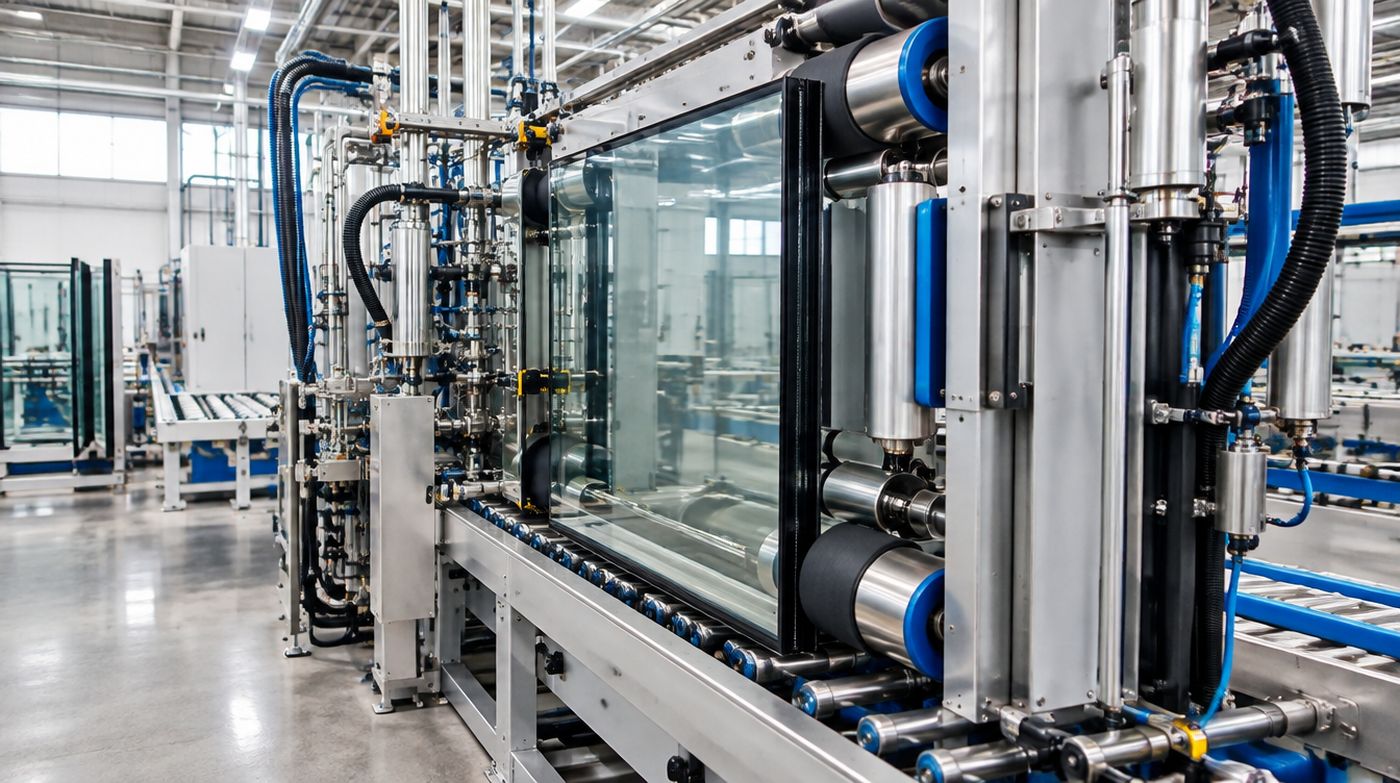
A glass processing workshop that happens to sell to the trade
We run a glass workshop at 6 Atlas Road in Wembley. We cut, we edge and polish, we toughen, we laminate and we make up sealed units under the same roof. The trade supply side exists because a workshop that is already processing glass every day can make units for other people efficiently, not because we decided to add a product line.
That shapes everything about how we deal with trade customers. We do not have a retail sales operation chasing your customers, we are not quoting against you on the jobs you measure, and we have no interest in the fitting. If you are a window company in Harrow, a joinery shop in Park Royal or a shopfitter working across the West End, we are a component supplier and we would like to stay one.
What we process in house, and why it matters to your programme
Toughening in house is the part that changes your lead times most. When a toughened leaf is made on the same site as the unit it goes into, the glass does not go out to a third party, sit in somebody else’s queue and come back on their schedule. It also means that when a toughened piece breaks during processing, which occasionally happens, it is remade here rather than reordered from elsewhere.
The same applies to laminated work, polished edges, odd thicknesses and shaped pieces. Having the processing under our control is what lets us say yes to the awkward lines on your order: a non-standard overall thickness to suit a shallow timber rebate, one toughened leaf and one annealed where the position only requires safety glass on one side, a stepped unit for an old frame, a single replacement in an existing run matched to what is already there.
How an order actually runs through the workshop
A cutting list comes in. It is read before it is priced, and if something looks inconsistent with the rest of the order, a size that does not match the others on the same elevation, a make-up that will not fit the bead thickness you have quoted elsewhere, a toughened line with a size that cannot be adjusted later, we query it. Confirmed lists go into the schedule with the long lead items started first.
Glass is cut, worked, washed and assembled, and the units are labelled as they are made so that what arrives on your van can be matched line by line against the list you sent. Units are stored and transported standing on edge on racks, never flat stacked, because a sheet supported across its face takes bending loads it was not designed to take and because a unit loaded face down puts its whole weight through the edge seal.
Then it is either collected from Wembley or delivered on a booked round. Both are fine. Collection suits short notice work and small quantities, delivery suits full jobs and site work, and the choice is usually dictated by what else your van is doing that morning.
What we will not do
Being clear about this saves everyone time:
- We do not sell single units to the public. Homeowners with misted double glazing are sent to our sister site, which measures and fits.
- We do not measure your job. The sizes on the list are yours, and that is the arrangement that makes trade pricing possible.
- We do not glaze trade units. If a unit needs fitting we are not the people doing it.
- We do not quote on a verbal size. Everything we cut comes from something written down.
- We do not cut toughened glass after it has been treated, because nobody can. A changed size is a new piece.
- We do not guarantee a unit glazed into a rebate without working drainage, and we will say so before you order rather than after you claim.
Standards, marking and the paperwork you should expect
Sealed units are made to BS EN 1279, which covers dimensional tolerance, moisture penetration, gas leakage, sealant performance, conformity and the factory production control behind all of it. Toughened glass is to BS EN 12150, laminated to BS EN 14449, and safety glass for critical locations is specified against the impact classification in BS 6206 and the guidance in Approved Document K. Where glass forms a barrier, BS 6180 barrier loading governs the make-up, and thermal performance for replacement work is judged against the current edition of Approved Document L on a whole window basis rather than on the centre of the glass.
On the installation side of the business we are a FENSA registered installer, and our own installation teams are employed rather than subcontracted. That is not directly relevant to a trade order, but it is the reason we can talk sensibly about glazing practice and about what building control will accept, because we deal with both ends of it.
Ask for the specification in writing on anything that matters, from us or from anyone else. A line on a delivery note that records the make-up of each unit is worth having five years later when a customer asks what is in their windows, and it is worth having five days later when somebody disputes a thickness.
Our guarantee, and the things that genuinely void it
A sealed unit guarantee covers the unit failing as a unit: loss of the hermetic seal, moisture or misting inside the cavity, failure of the seal itself. It does not cover breakage, scratches found after glazing, surface condensation on either face of the glass, or the unit’s performance in a frame that was not fit to take it.
The exclusions that bite in practice are all glazing related, and they are the same everywhere in the industry. A unit bedded in a rebate that holds water. A unit glazed without setting blocks, so the weight bears on one corner. Packers or fixings bridging the cavity and transferring movement into the edge seal. Insufficient edge cover, leaving the secondary seal exposed to direct sunlight. Contact with fresh mortar or render, where alkaline run-off attacks the sealant. Units stored flat on site, or stood in water on a wet slab for a fortnight before anyone glazed them.
None of that is a way of wriggling out of claims. It is a description of how units die in the field. If you glaze into drained rebates, block properly, keep the seal covered and store units upright and dry, genuine unit failures become rare enough that the guarantee is almost theoretical.
How disputes arise, and how we would rather settle them
Nearly every dispute in trade glass supply is one of three things. A size that is not what one party thought it was. Damage with no agreed point of origin. Or a change nobody recorded.
All three are prevented by evidence created early and cheaply. Written lists, numbered lines, a confirmation before toughened glass is cut, a check against the list while the driver is still at the kerb, a note on the paperwork and a photograph if anything is chipped. A unit that is signed for clean and found damaged a week later is genuinely difficult, because by then it has been on a van, on a stillage, possibly up a scaffold, and no honest person can say where it happened.
Where it is our error we fix it fast and without a negotiation. Where it is not, we will still help, usually by remaking at cost and prioritising it, because the fitting day you are trying to protect is worth more to both of us than winning the argument. What we will not do is pretend a drainage failure was a manufacturing failure, because the next unit into that frame will fail the same way.
What we would rather you asked before you ordered
Three questions prevent most of the trouble, and none of them cost anything to ask. What is the rebate depth and the bead, because that decides the maximum overall thickness before any performance discussion starts. How much edge cover will the unit have once it is beaded, because that decides whether the secondary seal is protected or exposed. And does the frame drain to the outside, because that decides whether the unit has a long life or a short one.
After those, the useful ones are about position rather than product. Which elevation is it on, is the glass partly shaded by a reveal or a canopy, is it a critical location, does it form a barrier, and is there a performance figure the job has to prove to building control. Answer those and the make-up usually writes itself. We are happy to have that conversation on the phone before a cutting list exists, and it is not a sales call, because we are not quoting against anybody for the fitting.
Made to order, which is why we ask so many questions
We hold glass stock. We do not hold sealed units, and nobody sensibly does, because a unit is only useful at one exact size with one exact make-up. That is worth understanding when you compare suppliers on lead time. A company offering units off the shelf is offering you either a very narrow range of sizes or somebody else’s manufacturing queue with their name on the invoice.
Made to order also means a change costs time rather than money up to a point, and then costs both. Before the glass is cut, a change is a phone call. After cutting, it is a remake of that line. After toughening, it is a remake from raw stock, because treated glass cannot be re-cut. Tell us about a change the moment you know about it and most of the time it will cost you nothing at all.
Opening a trade account
Call 020 4634 6045 or come to the workshop at 6 Atlas Road, Wembley HA9 0JH, Monday to Friday 8am to 5pm. Bring or send a real cutting list rather than a hypothetical one. The quickest way to find out whether a supplier suits you is to put a small genuine order through and see how the sizes, the lead time and the delivery actually behave, and that is how we would judge a new supplier too.
Send your cutting list
One line per unit with sizes, build and spacer colour. We quote the same working day and confirm the lead time with the price.