Glass sealed units made to measure: tolerance, squareness and shape
Made to measure sounds like a promise of exactness. It is really a promise of a stated tolerance, held consistently, on dimensions somebody else surveyed. Knowing where the tolerances sit is how you stop paying for remakes.
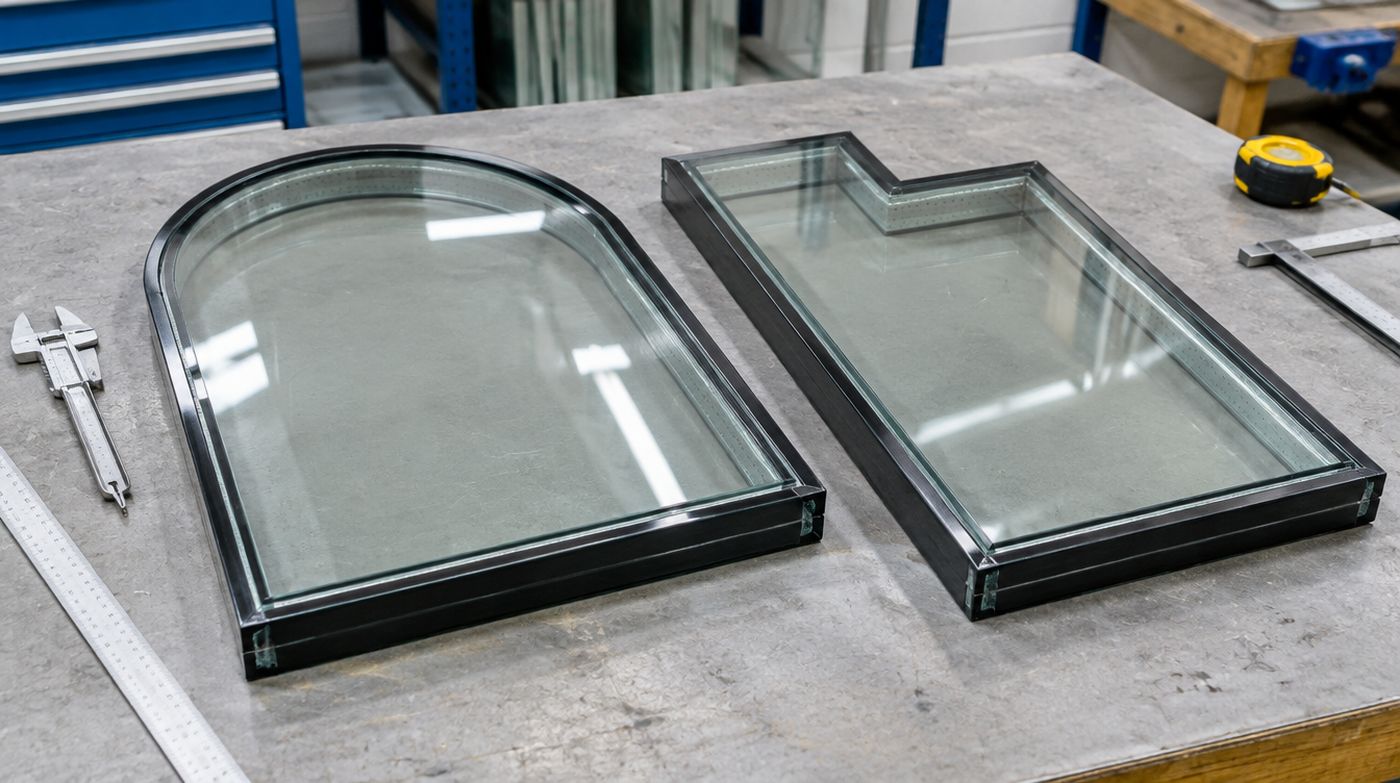
Glass sealed units made to measure: what the tolerance actually is
Glass sealed units made to measure are cut, seamed, washed, assembled onto a spacer, pressed and sealed, and every one of those operations has a tolerance attached to it. The cut has a tolerance. The spacer bend and joint have a tolerance. The press has a tolerance on overall thickness. The standards allow a small amount either way on each dimension, a little more on long sides than short ones, and good practice holds tighter than the standard permits. What nobody can offer is a unit made to an exact nominal figure, because glass is cut by a wheel against a stop and not grown to size.
This matters to you in one specific way. Your deduction has to absorb three tolerances, not one: ours on the glass, the frame maker’s on the rebate, and your own on the survey. That is why clearance and setting blocks exist, and why a unit cut dead on the sight size will not go in even when every measurement on the page was right.
What we need from a cutting list is set out on the home page. This page is the other half of the conversation: what happens to your sizes once they reach the workshop, and which shapes and dimensions behave differently from a plain rectangle.
Squareness, and why your rectangle probably is not one
Measure both diagonals of the opening before you write down a width and a height. If they differ, the frame is not square, and you have a decision to make rather than a measurement to take. A couple of millimetres across a domestic casement is normal and the clearance will swallow it. Ten millimetres across a diagonal is a racked frame, and a square unit put into it will show an uneven sightline on two sides and, worse, may bear on one corner.
Glass that bears on a frame corner is a crack with a date on it. The load concentrates at the one point where the glass has no give, and the first cold night with a bit of frame movement finishes it. Nobody will call that a manufacturing fault and nobody will pay for it either.
Where a frame is genuinely out of square, you have two honest options. Reduce the unit so the clearance covers the error, accepting that the bead will show more on one side, or order the unit as a parallelogram with the corner dimensions and both diagonals stated. We will make the second, and for anything beyond a few millimetres of racking it is the right answer. Racked frames are common in older London stock, particularly timber sashes in settled terraces and bays that have moved on their own footings.
When to send a template instead of a dimension
Anything that is not a rectangle with four right angles is better templated than described, and some things can only be templated. Arched and segmental heads, raking tops to stair and gable windows, bullseyes and circles, cut corners, radiused corners, trapeziums, and any opening with two non parallel sides all fall into that group. A template takes ten minutes on site and removes every ambiguity that a description leaves behind.
- Make it full size on rigid board. Hardboard, thin ply or MDF. Not card, not paper, not a photograph with a tape measure in it.
- Template to the glass size you want, or to the rebate line with the deduction written on it. Say clearly which one you have done.
- Mark TOP and mark which face is the outside. A handed shape templated the wrong way round comes back as a mirror image of the one you need.
- Write the job reference, the unit reference and the quantity on the board itself, not on a separate sheet.
- Give the square sizes as well: overall width, overall height, and the height to the springing point on an arch.
- Send one template per shape and tell us how many units to make from it.
Arches, springing lines and tight radii
An arch is three different shapes in common use and they are not interchangeable. A true half round has a radius equal to half the width and springs from the sill or from a straight leg. A segmental head is a flatter arc struck from a centre below the springing line, described by its width and its rise. A gothic head is two arcs meeting at a point. If you give us a width and a height and call it an arch, we have to guess which of the three you mean, and the guess will be the common one, not necessarily yours.
Tight radii and sharp points also behave differently in a toughening furnace. A fine point concentrates stress and may not survive the process, and small radius corners can distort. Where a design calls for a genuine point in safety glass, laminated construction is usually the better answer, or the point is slightly blunted by agreement. We will tell you which applies before the glass is cut, not after.
Stepped units, and why they are a different product
A stepped unit has one pane larger than the other, so the oversized pane overlaps the frame rather than sitting inside a rebate. They turn up on older aluminium systems, on patent and roof glazing, on conservatory bars, and on structurally glazed openings where there is a rebate on two or three sides only. When you order one you have to state the step dimension, which pane is oversized and on which edges the step runs. A unit stepped on the wrong edge is scrap.
The reason they cost more is not just the extra cutting. The exposed part of the edge seal on a stepped unit sees daylight and weather, which an ordinary unit never does, so it needs a secondary seal that tolerates ultraviolet light. That is silicone rather than polysulphide, which changes the process and the price. It also makes the stepped edge the vulnerable edge, and on anything close to horizontal where water can sit, that edge is the one that will eventually let go.
So ask the obvious question before you order: does the detail actually need a step? On a great many replacement jobs, a standard unit with a cover trim or a packed rebate does the same job for less money and will outlast the stepped alternative. We make stepped units regularly and we would still rather you used one only where the frame leaves you no choice.
Minimum and maximum sizes, and what breaks at each end
At the small end, the limits come from the spacer and the furnace. A spacer frame has to be bent or jointed at each corner and the desiccant has to fit inside it, so below a certain size there is physically nowhere for the corner to go. Very small toughened panes also distort in the furnace and can show tong or roller marks across most of their area. There is a commercial limit too: a 200mm square unit costs more than its area suggests, because it takes the same handling time as something ten times the size. If you have a schedule of tiny units, ask how the minimum charge works before you compare prices per square metre.
At the large end, the constraints are the furnace bed, the press, the weight and the doorway at the other end. Glass weighs roughly two and a half kilos per square metre for every millimetre of thickness, so a 4-20-4 unit at two and a half square metres is already around fifty kilos before anybody tries to get it up a staircase in a Victorian terrace. Large units also need thicker glass, not for strength alone but for deflection: a big pane in 4mm visibly bows under wind pressure, and that movement pumps the cavity and works the edge seal every day of its life.
The limit people forget is the aspect ratio. A long slender unit, say 250mm by 2400mm, is awkward for reasons that have nothing to do with area. The spacer has very little to brace it over that length, and under pressure differences the two panes can bow towards each other, which shows first as interference patterns and at worst ends in the panes touching. If a design gives you a very long thin light, tell us the proportions when you ask for the price, because the answer may be a thicker build rather than the standard one.
Where made to measure costs you money for nothing
Do not template a rectangle. If the opening is square and you can measure it, a size on a list is faster, cheaper and less likely to go wrong than a board in the back of a van. Do not ask for a tolerance you cannot survey to either. Half a millimetre on a unit means nothing when the frame it is going into was made to two and the tape was held by somebody balanced on a ladder.
Two more. If the frames are being replaced within a year or two, do not pay for shaped glass sealed units made to measure for them now. Fit plain glass, or clear toughened if the position calls for it, and buy the shapes once, with the new frames. And never invent a radius. A guessed arch is scrap glass, and the ten minutes a proper template takes is the cheapest insurance in this trade.
Sizes, templates and shapes can come to the workshop at 6 Atlas Road, Wembley HA9 0JH, Monday to Friday 8am to 5pm, or ring 020 4634 6045 if you want to talk a shape through before you cut a board.
FAQ
Questions about glass sealed units made to measure
How accurate are made to measure sealed units?
Every stage of manufacture carries a tolerance, so units are made to a stated tolerance rather than to an exact nominal figure. The published standards allow a small variation on each dimension, slightly more on longer sides, and a careful workshop holds inside that. What matters on site is that the tolerance is known and consistent, because your deduction has to absorb ours on the glass, the frame maker’s on the rebate, and your own on the survey. That combined allowance is why setting blocks and edge clearance exist, and why a unit cut to the exact sight size will not go in.
Do you need a template for an arched sealed unit?
For anything other than a true half round with a stated radius, yes. Segmental and gothic heads cannot be described reliably by a width and a height, because the same two figures fit several different curves. Make the template full size on rigid board, mark the top and the external face, and write on it whether you have templated the glass size or the rebate line. Send the overall width, the overall height and the height to the springing point with it. Ten minutes with a sheet of hardboard removes every assumption from the order.
What is the smallest sealed unit you can make?
The limit comes from the spacer rather than the glass. A spacer frame has to turn a corner and hold desiccant inside it, so there is a point below which there is nowhere for the corner to go, and very small toughened panes can also show distortion from the furnace. Small units are also charged against a minimum area, because they take as much handling as a large one. If you have a list of small lights, ask how the minimum charge is applied before comparing square metre rates, since the headline figure will not reflect what you actually pay.
Send your cutting list
One line per unit with sizes, build and spacer colour. We quote the same working day and confirm the lead time with the price.