Double glazed sealed units, specified properly
Most sealed unit orders arrive with half the specification stated and the rest left to the maker. This page is about what each part of the build actually does, and how to write it down so the unit that turns up is the one you intended.
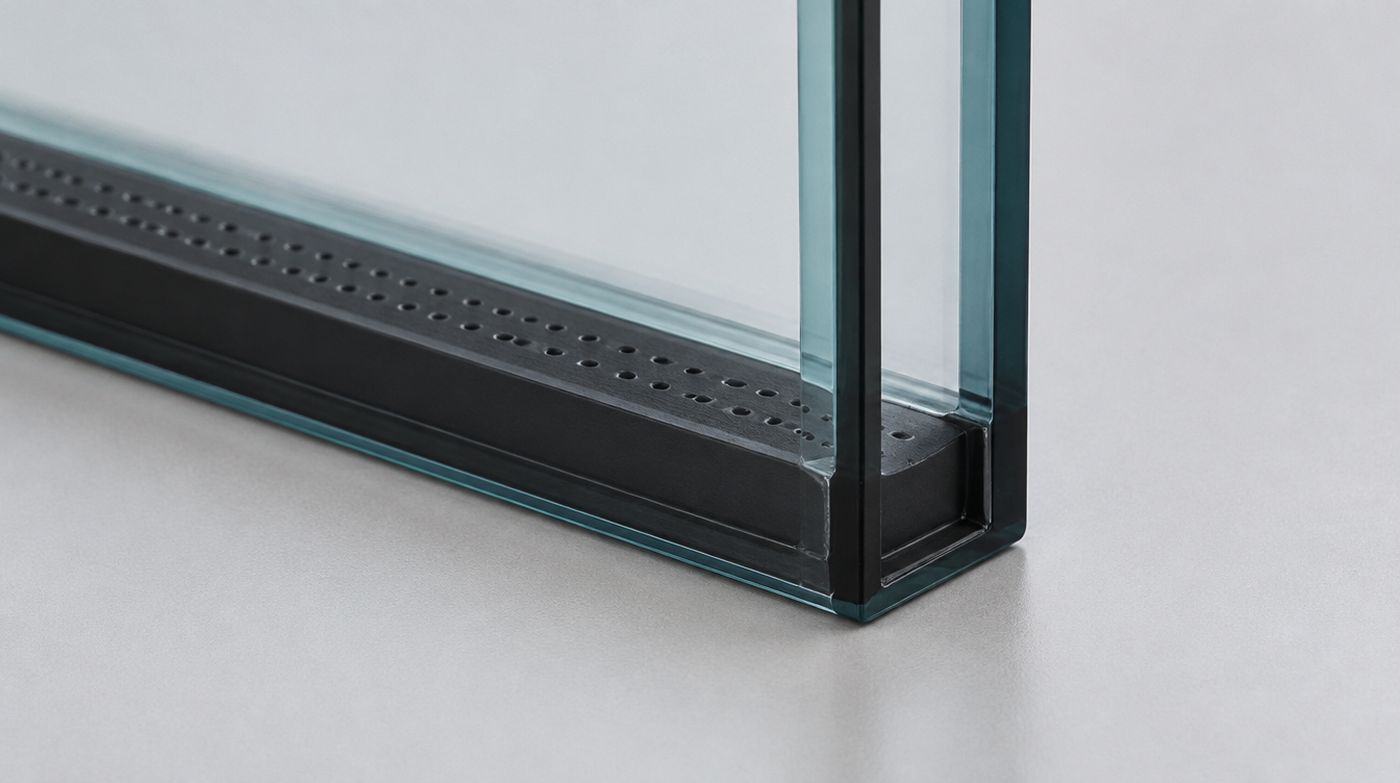
What you are actually choosing when you order double glazed sealed units
Double glazed sealed units are not one product with one price. Every unit is six decisions: the overall thickness, the glass in the outer leaf, the glass in the inner leaf, which coating and which face it sits on, the spacer, and what fills the cavity. Change any one of those and you change the performance, the cost, or whether the unit goes into the frame at all. Most cutting lists we price state two of the six and leave the other four to us.
We will make a sensible assumption on anything missing, and the assumption is usually low iron free 4mm clear outer, soft coat low-e inner, warm edge, argon. That is a good default. It is not the same thing as the unit you had in your head when you priced the job for your customer.
How a unit is built, and what the testing behind BS EN 1279 proves about it, is covered on the manufacturers page. This page stays on the specification itself. What does each choice buy, and at what point does paying more stop buying anything at all.
Cavity width: what 6mm, 12mm, 16mm and 20mm actually do
The cavity does most of the thermal work, and it does it by holding gas still. Below roughly 10mm the two panes are close enough that heat crosses the gap too easily, and the unit performs badly no matter what coating you hang on it. Widen the gap and performance improves, up to a point. Around 16mm with argon in it, you are at the practical optimum. Go wider and the gas inside begins to circulate, warm at one face and cool at the other, and convection starts to carry heat across the gap that the still air was blocking.
That is why a 28mm unit built 4-20-4 with argon is not meaningfully better at the centre of the pane than a 24mm unit built 4-16-4 with argon, and can measure very slightly worse. The reason to specify 28mm is the frame. Most modern PVCu casement and tilt and turn systems are designed around a 28mm rebate, the sightline suits it, and the bead is made for it. Specify to the rebate, not to a number you want on a quotation. In practice most double glazed sealed units we make for London trade customers are 24mm or 28mm overall, and the frame decides which.
Narrow cavities exist for a reason and the reason is always the frame. Steel windows, slim timber sashes, old aluminium and some conservation systems have a rebate that will take 12mm, 14mm or 16mm overall and nothing more. In those windows you are not choosing between a 6mm cavity and a 16mm cavity. You are choosing between a unit that fits and a unit that does not. Accept the thermal compromise, specify krypton if the cavity is genuinely narrow, and spend the saved money on draughtproofing the frame, which in an old sash is where the heat is actually going.
Coatings, and the surface they belong on
Surfaces in a double glazed unit are numbered from outside in. Surface 1 is the weather face of the outer pane. Surface 2 is the cavity face of the outer pane. Surface 3 is the cavity face of the inner pane. Surface 4 is the room face. Getting the number right in a specification is not pedantry. It is the difference between a unit that keeps heat in and a unit that keeps heat out.
A low emissivity coating for heat retention belongs on surface 3. From there it reflects long wave heat radiating off your radiators and your occupants back into the room, while letting short wave solar energy in. A solar control coating belongs on surface 2, where it intercepts solar energy before it has crossed the cavity and warmed the inner pane. Put a heat retention coating on surface 2 and you have not ruined the unit, but you have turned part of its job into something else and lost winter solar gain you were counting on.
Soft coat and hard coat are not interchangeable
Hard coat, or pyrolytic, low-e is baked into the glass during manufacture. It survives handling, it can be toughened and cut like ordinary glass, and it can face a room or the weather. It is also noticeably less efficient and carries a faint haze that shows on a dark day. Soft coat is sputtered on afterwards, performs much better, and will oxidise if it is ever exposed. It has to live inside a sealed cavity. If somebody offers you a single glazed low-e pane for a secondary unit, it is hard coat, and you should know that before you compare its figures with a soft coat unit.
Soft coat also has to have its coating ground off around the perimeter before the unit is sealed, so the sealant bonds to glass rather than to a film that can be peeled. Hold a finished unit up to the light and you can usually see that deletion band as a narrow border behind the spacer. If a unit has no deletion band and the coating runs under the sealant, it has a shortened life whatever the warranty says.
Spacer bars: warm edge, aluminium and what the customer will see
An aluminium spacer conducts heat around the edge of the unit efficiently, which is the one thing you do not want it to do. The result is a cold band around the perimeter of the inner pane, and in a kitchen or bathroom in winter that band is where condensation appears first. A warm edge spacer, whether stainless, polymer or a composite, raises that edge temperature and moves the problem. It improves the whole window figure as well, though by less than most sales literature implies. The real argument for warm edge is the edge condensation and the appearance, not the headline number.
Colour is worth thinking about once and then not again. On an internally beaded PVCu window with a shallow sightline, the spacer is visible from inside and out, and a black or grey spacer in a dark frame looks deliberate where a bright aluminium one looks like an afterthought. On a deep timber rebate or a sash box where only a millimetre or two shows, nobody will ever see it, and you are paying for a detail that does not exist. We will quote whichever you ask for and we will tell you when we think it makes no visual difference.
Gas, briefly
Argon as standard is the right default and we fill as standard. Krypton earns its place only in a narrow cavity, under about 10mm, where argon has no room to work. Beyond that it is money spent on a number in a calculation. We have set out what can and cannot be claimed about gas retention over time on the home page and will not repeat it here, beyond the one practical point: nobody can tell by looking at a unit in the back of a van what is inside it, so buy the fill from somebody whose process you are willing to trust.
How to write a specification a processor can price without ringing you back
A clean specification line prices itself. A vague one comes back as a question, and the question costs you half a day. The order below is not house style, it is the order that removes ambiguity, because it forces you to describe the unit from the weather face inwards.
6mm toughened clear / 20mm warm edge black / argon / 4mm soft coat low-e, coating to surface 3. 28mm overall. 896 × 1243 tight size. 6 off.
Describing the build from outside in matters more than it sounds. Left to right is ambiguous on a page and a sheet of paper has no weather side, which is exactly how coatings end up on the wrong face. State the coating surface as a number and the argument disappears.
- Overall thickness, stated separately from the build, so an arithmetic slip is caught.
- The build from outside in, with the thickness of each leaf.
- Coating type and the surface number it goes on.
- Spacer type and colour.
- Cavity fill.
- Toughened or laminated, and whether a visible standard mark is required and where you want it.
- Shape, and whether a template follows.
- Sizes, which dimension is the width, and whether these are tight sizes or sight sizes.
The last point is the one that causes the most remakes in this trade. Tight size is the size of the glass. Sight size is what you can see once the beads are on. If your list does not say which it is, somebody has to guess, and the guess is yours to pay for. Say it once at the top of the sheet and it covers the whole list.
Where the money stops buying anything
Chasing a centre pane U-value below about 1.0 on a standard domestic window is spending in the wrong place. By the time the unit is in a frame, with a spacer edge, a sash and an installation around it, the whole window figure is governed by the frame and the fitting, not by the last fraction you bought in the glass. If a customer is comparing two quotations on centre pane numbers, tell them to ask for the whole window figure instead and watch the comparison change.
Three more places not to spend. Krypton in a 20mm cavity does nothing you can measure. Self cleaning glass on a ground floor window somebody can reach with a cloth is a cost with no outcome, and it is worth having where access genuinely is the problem, such as a roof or a tall stairwell window, and nowhere else. And toughening everything on a schedule as a blanket precaution is a habit, not a specification. Approved Document K sets out which positions are critical. Specify safety glass where the regulation and the use call for it, price the rest as annealed, and put the saving into the glass that is actually at risk.
One last thing worth challenging in somebody else’s quotation. If you have been offered an acoustic double glazed unit built with two panes of the same thickness, question it. Two identical panes resonate together and the unit performs very close to a standard one. Asymmetry is where acoustic performance comes from, and if the quotation does not show two different glass thicknesses, it is not an acoustic unit, whatever it is called on the paperwork.
We make double glazed sealed units to order in Wembley, so a build can be changed on the list rather than argued about afterwards. Send a cutting list to the workshop at 6 Atlas Road, Wembley HA9 0JH and we will price it the same day, or ring 020 4634 6045 and talk the build through before you commit to a figure on your own quotation.
FAQ
Questions about double glazed sealed units
What thickness are standard double glazed sealed units?
In the UK the two common overall thicknesses are 24mm, usually built 4-16-4, and 28mm, usually built 4-20-4. Older PVCu and aluminium frames often take 20mm, and slim timber sashes, steel windows and conservation systems can be down at 14mm or less. The thickness is decided by the rebate in the frame, not by the performance you want. Take a bead off one window and measure the rebate depth and the glazing platform before you order anything, because a unit that is 4mm too thick will not bead up, and one that is too thin rattles in the gasket.
Which way round does a low-e sealed unit go in the frame?
The coated pane goes to the inside of the building, with the coating facing the cavity, which is surface 3. Fitted the wrong way round the unit still works, but it behaves more like a solar control unit and you lose winter heat retention. Ask your supplier to mark the coated pane before it leaves the workshop. If a unit is already fitted and you need to check, hold a flame up to the glass at an angle in a dim room and count the reflections. One of the four images will be a noticeably different colour from the others, and its position in the sequence tells you which surface carries the coating.
Is a 28mm double glazed unit better than a 24mm one?
Thermally, barely, and in some builds not at all. Argon in a cavity performs best at around 16mm. Widen the gap to 20mm and convection inside the cavity starts to work against you, so a 4-20-4 argon unit measures roughly the same as a 4-16-4 argon unit at the centre of the pane. The reason to choose 28mm is that the frame system was designed for it, the bead fits it and the sightline suits it. It is not a reason to change a frame, and it is not an upgrade worth paying extra for in a window that was built for 24mm.
Send your cutting list
One line per unit with sizes, build and spacer colour. We quote the same working day and confirm the lead time with the price.