Sealed unit manufacturers in London
How a unit is actually made, what to specify, and what separates a unit that lasts twenty years from one that fails in five.
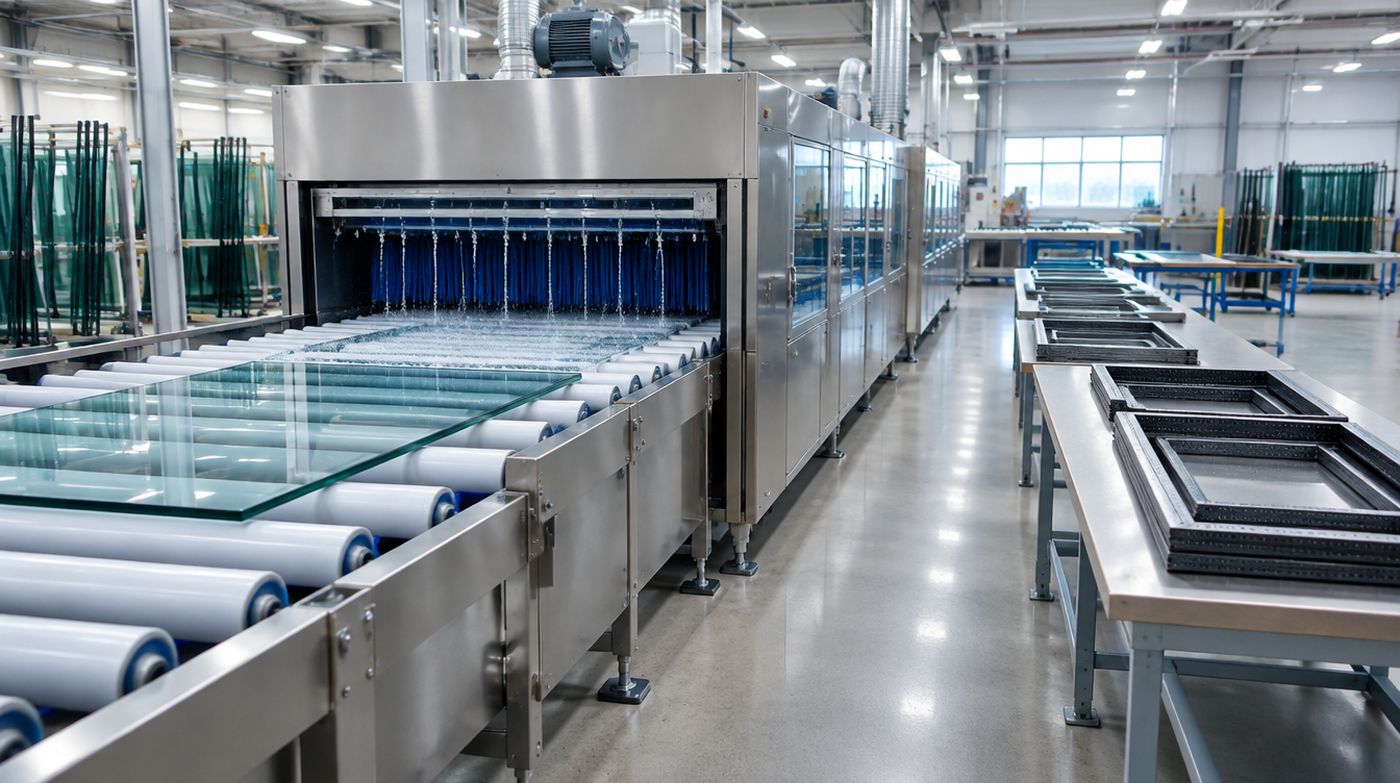
Sealed unit manufacturers in London mostly fall into two camps: processors who make their own glass and factors who buy units in and put their label on the box. We are in the first camp. Sealed units are made at 6 Atlas Road in Wembley, in the same building where we cut, edge, polish, toughen and laminate the glass that goes into them, which means a toughened or laminated component does not leave the premises and then come back late. Trade only, from your cutting list, for window companies, builders, glaziers, shopfitters and conservatory installers across London.
What follows is the detail of what actually happens to your order, because you can only specify well and argue well if you know how the thing is built.
How a double glazed sealed unit is made, stage by stage
1. Cutting
Glass is scored and broken out of stock sheet on a cutting table, then the edges are worked. The score line and the break decide the quality of the edge, and the edge decides a surprising amount. A clean arrissed edge with no shells or vents is far more tolerant of thermal stress than a ragged one, which matters in annealed glass on a sunny elevation with partial shading from a reveal or an overhang. Most unexplained cracks that run from the perimeter inward started at a damaged edge, not at an impact.
Coated glass is handled at this stage too. Sputtered soft coat low-E has to have the coating removed around the perimeter so the seals bond to glass rather than to a thin metallic layer. Skip edge deletion with a coating that requires it and you have built an adhesion failure into the unit on day one.
2. Washing, and why it decides how long the unit lives
This is the stage nobody asks about and the one that quietly determines unit life. Glass comes off the cutting table carrying cutting fluid, glass fines, dust and handling marks. The washer takes it through brushes and a rinse, then dries it with air knives, and what matters is the water quality and the state of the brushes. Rinse with hard water and you deposit a mineral film. Run tired brushes and you move dirt around rather than remove it.
Everything after this point depends on adhesion, and adhesion is a surface condition. Butyl bonded to a contaminated surface looks identical to butyl bonded to clean glass. It behaves identically for a year or two. Then it releases, usually along one edge, and moisture starts moving into the cavity faster than the desiccant can absorb it. That is why a unit that fails at eighteen months is nearly always a washing or preparation problem and why units go from washer to assembly immediately rather than sitting around collecting dust.
3. Spacer and desiccant
The spacer is cut and formed to the unit size, either bent at the corners into a single frame with one joint, or assembled from straight lengths with corner keys. Bent corners give fewer potential leak paths, which is why they are preferred on anything where the specification is tight. Rigid spacers are filled with molecular sieve desiccant; flexible warm edge systems carry the desiccant within the spacer material itself.
Desiccant has a finite capacity and it starts using it the moment it meets the atmosphere. Its job is not to dry wet air out of your window forever. It is to absorb the small amount of moisture sealed in at manufacture and then the trickle that permeates through the edge seal over the years. When the desiccant is saturated, the unit mists. Everything that shortens that timeline, open desiccant left standing, a slow line, a unit that sat unsealed overnight, costs you years at the far end of the unit’s life rather than days at this end.
4. Primary seal
Polyisobutylene is extruded onto both faces of the spacer before assembly. This is the real barrier. The primary seal is what keeps water vapour out and gas in, and it is a thin continuous line that has to stay in full contact with glass on both sides, round every corner, with no breaks at the joint. Almost all genuine manufacturing failures are failures of this line, either because the glass was not clean, because the butyl was applied cold or thin, or because the corners were not properly closed.
5. Gas fill and press
Units are gas filled and pressed to the design cavity. The press squeezes the sandwich down so the butyl makes continuous contact and no air pockets remain in the primary seal, and the cavity ends up at the nominal dimension rather than somewhere near it. Cavity accuracy matters because the whole thermal calculation assumes it, and because a unit that is thicker than the order will not go into the bead.
6. Secondary seal and cure
The perimeter channel outside the spacer is filled with the secondary sealant. This is structural. It holds the two leaves together, carries the handling and wind loads applied to the edge, and protects the primary seal. Polysulphide is the common choice and performs well against moisture. Silicone is specified where the edge will see ultraviolet light or where the unit is structurally glazed, because silicone is the one that does not break down in sunlight. Hot melt butyl is used in some systems and sets as it cools.
Cure time is real, and it is the reason a unit ordered this morning is not always collectable this afternoon. A chemically cured secondary seal needs time before the unit can be handled hard, stacked, transported and glazed. Rushing it produces units that distort at the corners or that let go later under load. If a supplier can hand you polysulphide units an hour after they were pressed, ask them what they filled the channel with.
What BS EN 1279 actually covers
People quote BS EN 1279 at each other without saying which part they mean, and the parts are about quite different things. In outline:
- Part 1 sets the general rules, the system description and the dimensional tolerances a unit is held to.
- Part 2 is the moisture penetration test and the requirement for moisture ingress over a long term accelerated ageing cycle.
- Part 3 is gas leakage, covering both the gas concentration tolerance and the permitted annual loss rate.
- Part 4 covers the test methods for the edge seal components and sealants themselves.
- Part 5 is the product standard, the route to evaluation of conformity and marking.
- Part 6 is factory production control and the periodic testing a manufacturer has to keep doing to stay compliant.
The practical reading for a fitter is this. A unit conforming to the standard has been made under a controlled production system with ongoing test evidence behind it, not simply built to the right dimensions. When you are comparing prices and one is strikingly cheaper, the gap is often in Part 6 territory, which is the part nobody can see in a finished unit.
Argon, krypton and honest expectations on gas retention
A well made unit leaves the factory with a high argon concentration, and the standard allows a small percentage of that to be lost each year. Over a long life a unit will slowly trend down. That is physics, not a defect, and every manufacturer on earth is in the same position.
What is worth knowing is how little difference the back end of that curve makes. The step from air to argon in a standard cavity is a modest improvement in centre pane U-value, not a transformation. So a unit that has drifted from a full fill to somewhere comfortably below it after a decade performs very nearly as it did when new. Gas loss is not what makes old windows feel cold. Failed seals, poor frames, thin glass and draughts are.
Two things follow. First, be sceptical of anyone offering to re-gas units in situ. There is no credible way to refill and reseal a glazed unit in a frame and have it behave like a new one. Second, if a specification genuinely depends on hitting a particular U-value, the right move is to build the performance into the unit with the coating, the cavity and the spacer rather than to lean on the gas as the margin.
Specifying for Part L and Window Energy Ratings without getting caught out
The commonest and most expensive mistake in this trade is quoting a centre pane U-value as though it were the window’s rating. A unit described as 1.0 is describing the middle of the glass. The window is the glass plus the frame plus the edge of glass zone where the spacer conducts heat around the seal, and the whole window figure is always worse than the centre pane figure. Hand a building control officer a glass spec sheet in place of a window performance figure and you will be asked for it again.
Replacement windows in existing dwellings have to meet a whole window standard, expressed either as a Window Energy Rating band or as an equivalent whole window U-value. The threshold has tightened more than once, so check the edition of Approved Document L in force on the day the work is notified rather than the one you memorised. If the job is a new dwelling or an extension, the window figures feed the overall calculation for the building instead of being judged in isolation.
Window Energy Ratings also behave in a way that surprises people. The rating balances the solar heat the window lets in against the heat it loses and the air it leaks, so it is possible to make the glass more insulating, reduce the solar transmittance at the same time and end up with a worse band. If you are chasing a band rather than a U-value, say so when you order. We will specify a coating with that trade-off in mind rather than defaulting to the lowest centre pane figure on the shelf.
Toughened and laminated glass inside a sealed unit
Toughened content changes three things: lead time, tolerance and your margin for error. Toughened glass to BS EN 12150 is cut, worked and then heat treated, and after treatment it cannot be cut, drilled or notched. A wrong size is not an adjustment, it is a new piece from the start of the process. That is the real reason toughened lines have longer lead times than clear ones, and the reason we will query an unusual size on a toughened line before we commit the glass.
Tolerance is the second thing. Heat treatment introduces a small amount of bow and roller wave, which is normal and within the standard, and in a sealed unit it occasionally shows as a faint distortion in reflection. In large units with narrow cavities you may also see the leaves deflect with changes in atmospheric pressure and temperature, which is the unit breathing rather than failing. If you are glazing a run of big toughened units on a south elevation, tell your customer that beforehand rather than afterwards.
Specify safety glass where the position requires it rather than where it is easy to remember. The critical locations in Approved Document K, low level glazing, doors and the panels beside them, are the obvious cases, and glass in those positions has to meet BS 6206 Class A or the equivalent impact classification. Where a unit also forms a barrier, barrier loading under BS 6180 applies and laminated glass to BS EN 14449 is usually the right answer, because laminated holds together when it breaks and toughened does not. Laminated within a sealed unit also needs the correct sealant system, which is a reason to tell us the full make-up rather than just the overall thickness.
Triple glazed sealed units: when they are worth the weight
Triple glazed sealed units are heavier than people expect, roughly half as much again to double depending on the make-up, and the weight lands on hinges, on friction stays and on whoever carries them up a staircase in a terraced house in Islington. They are also thicker, which means the frame rebate and the bead have to accommodate them. A great many retrofit enquiries for triple glazing die on rebate depth alone.
Where they earn their place is in new frames designed for them, on exposed elevations, and in rooms where the comfort difference matters as much as the calculation. Where they rarely earn it is in an existing uPVC frame that was built for a 28mm unit, on an internal courtyard elevation, in a house that leaks heat through everything else. We will tell you if we think a triple is the wrong call on your job. It is a larger order for us and a worse outcome for you, and the second of those costs us more in the long run.
Glass sealed units made to measure: what we need from you
Every unit is made to measure. There is no stock, nothing is cut from a catalogue of standard sizes, and the order is only as good as the information behind it. For each line we need the finished glass size, the full make-up including thickness of each leaf and cavity, the glass type in each position, the spacer colour if it is not the standard, and anything that affects the look, such as obscure pattern and its orientation, Georgian bar layout, or a leaded design.
Shaped work is different. Arched heads, raking heads, segmental bays and anything curved come from a template rather than a dimension. A rigid template in hardboard or ply, marked with the face and the orientation, beats three numbers and a sketch every time. If a frame is visibly out of square, template it, because a rectangle made to the mean of four measurements will not fit a parallelogram.
Comparing sealed unit manufacturers in London: what to actually ask
Price per square metre tells you very little on its own, because the cheap number and the expensive number usually describe different products. If you are weighing up sealed unit manufacturers in London, the questions that separate them are about process rather than price. Do you toughen on site or send it out. What is the secondary sealant, and do you change it when the edge will be exposed. Do you edge delete coated glass. What is the water quality in the washer. What is the gas fill specification and how is it verified. Who carries the cost when a line is remade, and how fast does a remake go through.
Then ask the awkward one: what is the realistic lead time on a mixed order with one toughened line in it, not the brochure lead time on a plain unit. Any manufacturer can quote three days on clear double glazed sealed units. The useful supplier is the one that tells you honestly that your order finishes next Thursday because of line six, and then asks whether you would like the rest sooner.
We are not going to be the cheapest quote you get and there is no point pretending otherwise. What we will do is tell you before you order if the make-up you have specified is wrong for the position, and query a size that does not look right rather than cutting it and sending you an invoice.
Trade terms, lead times and remakes
Standard double glazed units with clear or coated float run on the shortest lead time. Toughened content, laminated, patterned stock we have to bring in, stepped units, shaped units, unusual spacer colours and bar work all extend it, and they extend it individually, so an order with one awkward line on it finishes when that line finishes unless you ask us to split the delivery. If part of a batch is urgent, say which part when you order rather than when you chase.
On remakes we try to be straightforward. If the unit is wrong because of how it was made, it is remade at our cost and it goes to the front of the queue. If the unit is wrong because of what was on the list, it is remade at cost price, quickly, with no argument about whose fault it was, because the argument is worth less than the fitting day you are trying to protect. Damage reported while the delivery is being checked is ours to sort out. Damage reported a week after a clean signature is a conversation, not a claim, and we will have it honestly.
Workshop and trade counter at 6 Atlas Road, Wembley HA9 0JH, Monday to Friday 8am to 5pm. Call 020 4634 6045 with a cutting list, or send it over and we will price it and tell you when it can be ready.
FAQ
Questions we get asked
Do you supply the public or trade only?
Both, but the pricing, lead times and process here are built around trade customers working from a cutting list. If you are a homeowner with one or two misted windows, a glass-only replacement service will be a better fit, because most of the cost of a single unit is the visit rather than the glass.
What should a cutting list contain?
One line per unit: width first then height in millimetres, the glass build for each pane, overall thickness, spacer colour, whether toughening is needed, and bar spacing or pattern where relevant. Mark the outer face on anything directional. State plainly whether sizes are the unit size or the aperture, because that single ambiguity causes most remakes.
Who is responsible if a size is wrong?
You are, if the sizes came from you. We manufacture to the list supplied and we will query anything that looks inconsistent, but we cannot verify a measurement we did not take. Where we survey, the sizes are ours and so is the remake.
What are your lead times?
Plain double glazed units are usually a few working days. Toughened, laminated, acoustic and patterned glass take longer because the processing is longer, and triple glazed units sit at the longer end. We confirm the lead time with the quotation rather than after the order.
Can you match an existing unit?
Usually. Bring or send a sample of the pattern where you can, along with the spacer colour and bar spacing. Common obscure patterns are still in production and we hold the usual ones. Discontinued patterns are the exception and are better discussed before you promise a customer a match.
Do you deliver, and how is the glass protected?
We deliver across London on scheduled rounds and units travel crated and on edge, labelled per line. Glass must never travel flat. If you are collecting, bring a vehicle that lets the units stand on edge and something to pad and strap them against.
Send your cutting list
One line per unit with sizes, build and spacer colour. We quote the same working day and confirm the lead time with the price.