Areas we cover across London
We work from our workshop at 6 Atlas Road, Wembley HA9 0JH, across Greater London and the near Hertfordshire border.
Core coverage
Where most of our work is
Being based in Wembley means north, west and central London are on our doorstep. These are the areas we are in most weeks.
- Wembley
- Harrow
- Brent
- Ealing
- Camden
- Westminster
- Kensington & Chelsea
- Hammersmith & Fulham
- Barnet
- Islington
- City of London
- Watford
Full list
Every area we survey and install in
- Wembley
- Harrow
- Brent
- Ealing
- Acton
- Willesden
- Kilburn
- Camden
- Islington
- Westminster
- Marylebone
- Fitzrovia
- Mayfair
- Kensington
- Chelsea
- Hammersmith
- Fulham
- Chiswick
- Shepherd's Bush
- Notting Hill
- Maida Vale
- St John's Wood
- Hampstead
- Highgate
- Finchley
- Barnet
- Mill Hill
- Edgware
- Stanmore
- Pinner
- Northwood
- Ruislip
- Uxbridge
- Hayes
- Southall
- Greenford
- Wood Green
- Enfield
- Walthamstow
- Hackney
- Shoreditch
- City of London
- Clerkenwell
- Southwark
- Battersea
- Wandsworth
- Richmond
- Twickenham
- Kingston
- Watford
- Bushey
- Borehamwood
Not on the list? If you are within the M25 it is worth a call. We travel for larger projects and can usually fit a survey around work already booked nearby.
What we do across these areas
- Sealed unit manufacturers in London
- Double glazed sealed units, specified properly
- Sealed unit replacement in London, from the surveyor’s side
- Glass sealed units made to measure: tolerance, squareness and shape
- Triple glazed sealed units: what the frame has to cope with
- Sealed units trade supply, from your side of the counter
- Searching for sealed units near me: what local actually buys you
The workshop at Wembley, and getting in and out of it
Everything is made at 6 Atlas Road in Wembley, HA9 0JH, in the industrial area north of the stadium. For collections that location is good news most of the time. You come off the North Circular, and the A406 gives you the whole of north west London within a short run, while the A40 a couple of miles south opens up the western corridor. Trade counter hours are Monday to Friday, 8am to 5pm, and the best time to collect is early, before the A406 thickens up between Neasden and Hanger Lane.
The exception is Wembley on an event day. When the stadium or the arena has a crowd in, the roads around South Way, First Way and Engineers Way go to controlled access, the parking restrictions extend well beyond the immediate streets, and a run that normally takes twenty minutes from the A406 can take over an hour. If you have a collection booked on a day with a fixture or a concert, come in the morning or move it. We will tell you if your collection date lands on one.
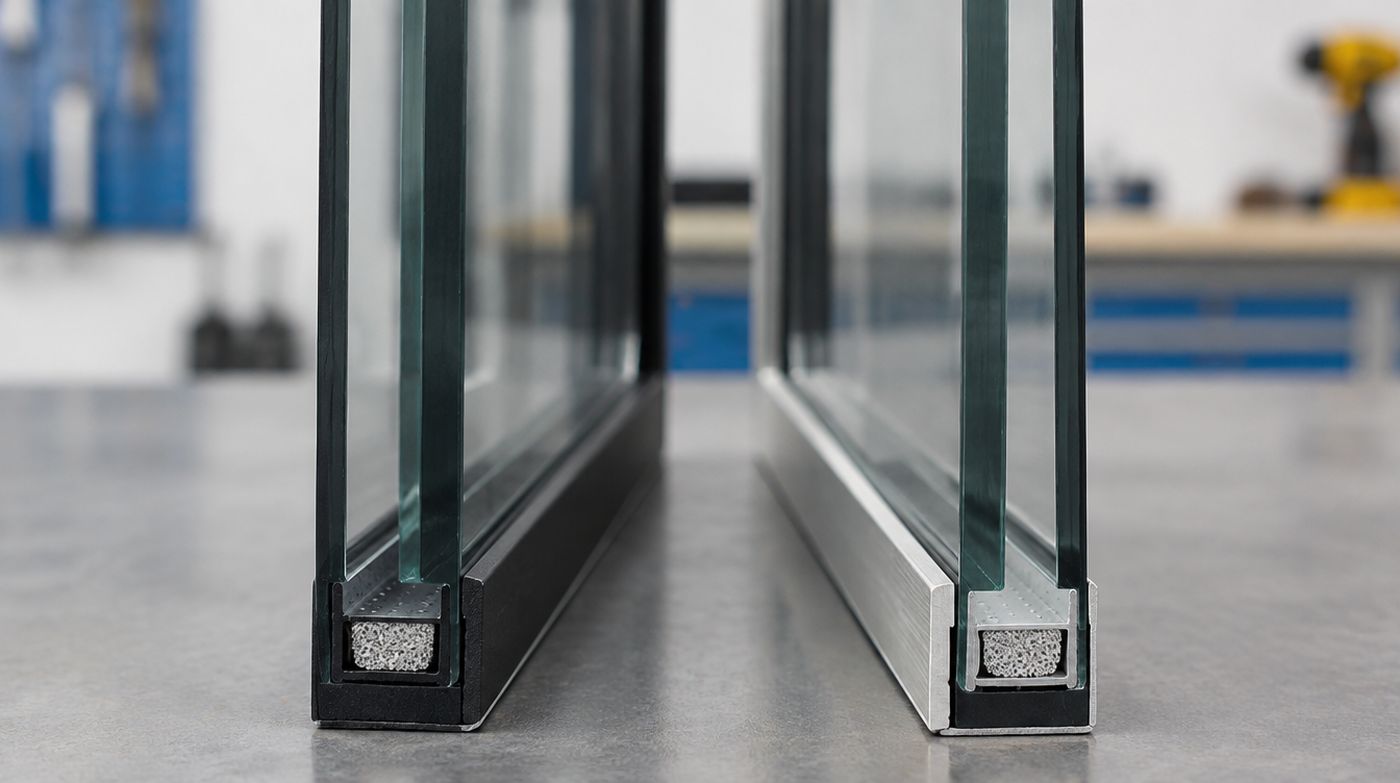
Bring the right vehicle. Units travel on edge, which means an A-frame or an internal frame, timber bearers, and straps that can be tensioned without bearing on a corner. A flat bed of blankets in the back of a transit is not a glass rack, and a unit laid flat across a van floor is being bent across its own face every time you hit a pothole on the Harrow Road. Large units are a two-person lift and the second person should be yours, not borrowed from whoever happens to be on the loading bay.
The north west and west trade belt: Park Royal, Acton, Perivale, Greenford and Hayes
This is where most of our delivery work goes, and it is where most of London’s window companies, joinery shops and glazing contractors physically are. Park Royal alone absorbs an enormous amount of the trade, and the same pattern runs out along the A40 through Perivale and Greenford to Hayes and Northolt, and south through Acton and Harlesden. From Atlas Road these are short runs, which means we can usually fit them into a round at short notice and often the same week an order finishes.
Deliveries into these estates are generally straightforward because the unloading happens on an industrial unit forecourt rather than at a kerb. What slows them down is the estate itself. Park Royal and the older Acton and Alperton estates have narrow internal roads, parked HGVs, shared yards and barriers, and a unit number that only makes sense if you already know the estate. Give us the gate, the unit and a mobile number that will be answered, because a driver circling an estate is burning your delivery slot.
Wembley, Alperton, Cricklewood, Willesden and out towards Harrow and Stanmore sit in the same band. Harrow and the hillier parts of Stanmore and Pinner add one wrinkle: residential streets with steep driveways and tight turns, where a long wheelbase van with a loaded rack has to be parked facing the right way before anything comes off.
North London: Barnet, Enfield, Edmonton and Tottenham
North and north east London is reached along the A406 or up the A10 and the Great Cambridge Road, and the trade is concentrated in the industrial areas around Edmonton, Brimsdown and Tottenham Hale. The run out is reliable outside peak hours and miserable inside them, so northbound deliveries go early and southbound returns avoid the late afternoon.
The residential work behind those estates is mostly interwar suburb in Barnet, Finchley and Enfield, with Victorian terraces closer in through Tottenham and Wood Green. For delivery purposes the difference is parking. The suburban streets in Barnet and Enfield usually give you a driveway or an unrestricted kerb within a few metres of the door. The terraced streets further in have permit parking, no side access, and a carry from wherever the van landed to a back garden through the house. If units are going into a back elevation on a street like that, tell us when you book so the load is stacked in the order you need to take it off.
Central and inner London: charges, red routes and timed bays
Deliveries into the centre are a different exercise and they need planning rather than optimism. The Congestion Charge applies on weekday daytimes and on weekend afternoons, the Ultra Low Emission Zone now covers the whole of Greater London, and larger goods vehicles have the Low Emission Zone standards on top. None of that stops a delivery. It just means the cost and the vehicle choice have to be decided before the round is built, not at the barrier.
The physical constraints bite harder than the charges. Large parts of the inner road network are red routes where stopping is prohibited outright, so the vehicle has to reach a loading bay or a side street, and many of those bays are timed, metered or restricted to short stays. Westminster, Camden, Kensington and Chelsea, Islington and the City all have streets where a glass delivery is realistically a fifteen minute window with someone ready at the kerb. If nobody is there, the driver cannot wait, because there is nowhere legal to wait.
Site deliveries into fit-outs add their own layer. Many city sites want a booked delivery slot, a vehicle on an approved list, a banksman for reversing, deliveries outside certain hours to satisfy noise conditions, and an induction before anyone walks past the hoarding. Goods lifts have dimension limits that frequently decide the maximum unit size before anything else does, and it is worth measuring the lift car and the door before a unit is ordered rather than after it is made. Units that have to go up a staircase need the turn at the half landing measured too.
Mansion blocks across Marylebone, Maida Vale, Bayswater and Chelsea behave like small sites. Expect a managing agent, a porter who controls access, restrictions on using the main lift for materials, and a stipulation that nothing is left in a common part. These deliveries work when someone has spoken to the building in advance and fail when they have not.
South and east London, across the river
The river is the real variable for everything south and east. Crossing times dominate the round: the Blackwall and Silvertown tunnels for the east, both of which now carry a toll, and the bridges from Tower Bridge westward through Vauxhall and Wandsworth to Chiswick and Kew. A delivery to Greenwich or Bermondsey that looks like a short distance on a map can take most of a morning from Wembley if it hits a tunnel queue, so eastern and southern drops are grouped and scheduled rather than slotted in individually.
Once across, the work splits much as it does in the north. The trade estates in Bermondsey, Deptford, Charlton and out through Erith and Dartford are easy to unload at. The Victorian terraces of Clapham, Peckham, Brixton and Lewisham are not, with controlled parking across most of the inner boroughs, narrow streets and the familiar problem of no side access to the rear. East London has the additional feature of the new residential blocks around the Docklands and the Royals, where the building has a loading bay, a booking system and a concierge, and where turning up unannounced simply does not work.
Outer sites and the edge of the M25
We deliver to outer London and the fringe, out towards Watford and Borehamwood, Uxbridge and Slough, Romford and the Essex edge, Croydon and Bromley to the south. These go on scheduled rounds rather than on demand, because the drive time only makes sense if the load justifies it. If you are an outer London account with regular work, it is usually worth agreeing a fixed delivery day and building your fitting programme around it, which costs you a little flexibility and gains you a lot of certainty.
Site deliveries versus workshop deliveries
A delivery into your own workshop or yard is the easy case. Somebody is there, there is hard standing, there is a rack to put the units on, and if a line is wrong you find out while the glass is still indoors and dry. A delivery to site is the hard case, because the glass arrives into a live environment where other trades are working, nothing is lockable, and the unit has to survive until the day it is glazed.
If you can take delivery at your unit and run the glass to site yourself, do it. Where that is not practical, the site needs somewhere dry, flat and vertical to store units, out of the path of other trades, away from fresh mortar and render, and not standing in water. Units left on a wet slab for a fortnight are a warranty problem waiting to happen, and so are units stacked flat under a sheet of plywood that someone then stands on.
Booking a slot and what has to be ready when the load arrives
Booking works best when we know three things: where the vehicle can legally stop, how long it can stop for, and who will be standing there. Add the access route, any lift or staircase restriction, and whether a permit or a dispensation is needed. For central deliveries, if a parking suspension or a site booking is required, that is your arrangement to make, because the building or the borough will only deal with the contractor.
On the day, have the labour there before the vehicle, have the route clear, and have somewhere for the units to go that is not the middle of the floor. Check the delivery against your own list while the driver is present. Count the lines, read the labels, check the sizes of at least the critical units rather than assuming, and run a hand along the edges and look across the faces for chips, scuffs and anything in the cavity.
If something is damaged or short, note it on the paperwork before you sign and photograph it where it stands. That single step is the whole difference between a replacement that is sorted out quietly in a few days and a conversation in a fortnight that neither of us can resolve fairly. We would far rather hear about a problem at the kerb in Harlesden than on the phone from a scaffold in Hackney.
Send your cutting list
One line per unit with sizes, build and spacer colour. We quote the same working day and confirm the lead time with the price.