Sealed units trade supply, from your side of the counter
Most writing about trade glass supply is suppliers describing themselves. This page is about the half of the relationship you control: how you receive glass, how you store it, how you order, and what you do when one breaks.
What a sealed units trade supplier is really selling you
A sealed units trade account is not primarily a discount. It is a date you can plan labour around. The glass itself is a commodity made from the same float, the same spacer and the same sealant everywhere in the country. What varies between suppliers is whether Thursday means Thursday, whether a remake comes back in two days or ten, and whether somebody answers the phone and gives you an answer rather than a promise to look into it.
We have written elsewhere on this site about what we expect from a trade customer and how an order runs through our workshop. This page deliberately looks the other way, at the things that go wrong on your premises and in your van, because that is where a surprising share of broken glass and lost days actually originates.
Checking a delivery in, and the twenty minutes that decide who pays
Your signature is the moment responsibility moves. Before it, a damaged unit is our problem. After it, it is a conversation. So the twenty minutes at the back of the lorry are worth more than they feel like when you are busy.
Count the units against the delivery note first, by reference, not by eye. Then look at the edges and the corners before you look at the faces. A nibble out of an edge or a bruised corner is the thing that becomes a crack three weeks after fitting, because glass breaks from edge damage under thermal movement, and when it does the break looks spontaneous. Face scratches you will notice anyway. Edge damage is what you have to hunt for.
Then check the edge seal for gaps or voids where the sealant has not filled, check that coated panes are marked so your fitter knows which way round the unit goes, and check that any toughened or laminated unit carries the mark where you asked for it. If anything is doubtful, write it on the note before you sign and photograph the stack while it is still on the vehicle. A clean signature on a delivery you did not look at is you accepting the glass as sound, and no supplier worth dealing with will pretend otherwise.
Storing sealed units without creating your own breakage
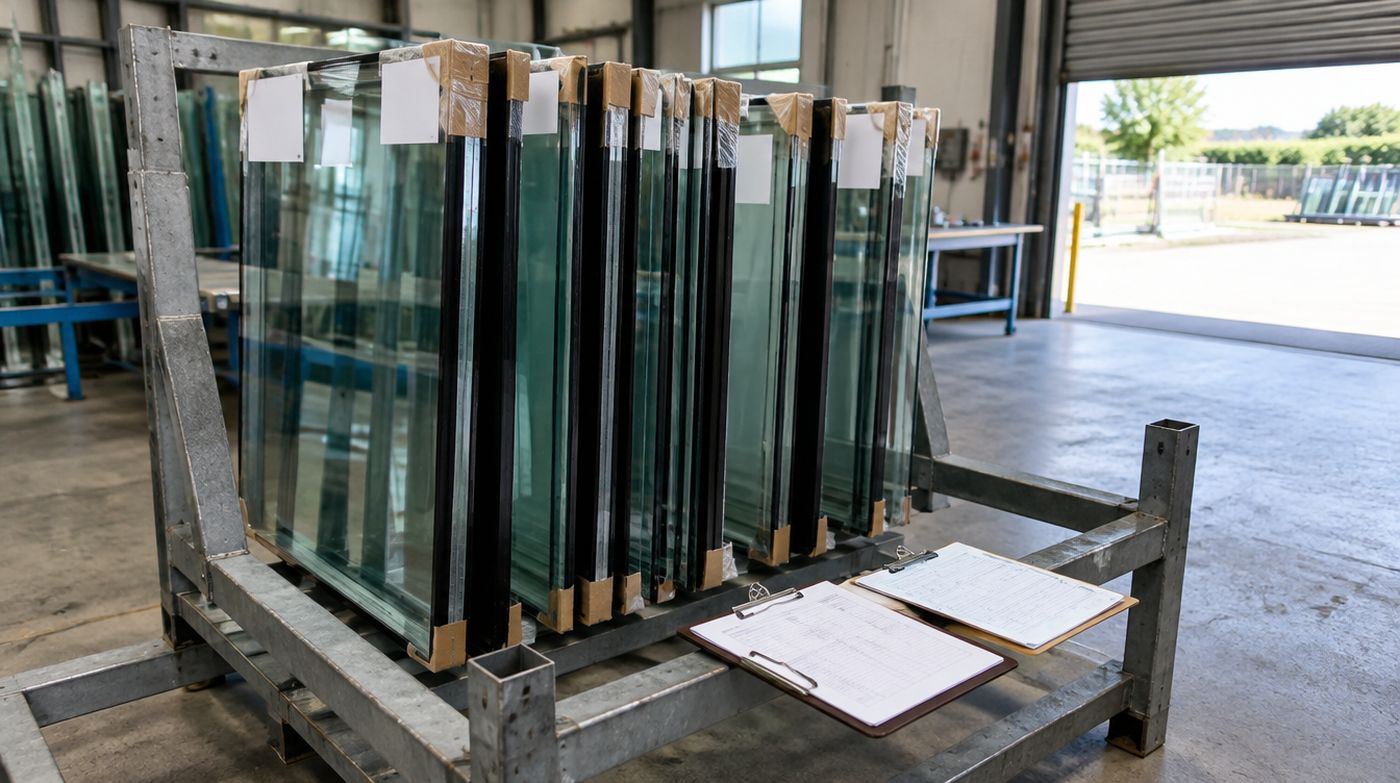
Units are stored on edge, never flat. A unit laid horizontally is supported in the middle by whatever is under it and loaded by its own weight at the edges, and on anything larger than a small light that is enough to work the seal. Stand them on timber battens or a rubber strip, leaning back at a slight angle against a wall or an A-frame, interleaved so faces are not rubbing against each other, with the bottom edge dry.
Keep them out of direct sun, and this is the part most yards get wrong. A stack of units still in shrink wrap, sitting in sun, becomes a heat trap with moisture inside it. Trapped condensation against a soft coat low-e surface will bloom the coating permanently, and nothing will clean it off. If units are going to sit for more than a day or two, take the wrap off, let air at them and keep them in the shade.
Two more yard habits worth fixing. Do not store glass anywhere near grinding, cutting or welding, because hot spatter pits the surface and the damage cannot be polished out. And do not mark the coated face with a chinagraph or a marker, because the coating is the surface you are writing on. Standing water on an edge seal does the same damage in your yard as it does in a frame, which is the point we make at length on the home page and will not labour again here.
Breakage and remakes: the glass is the cheap part
Work out what a fitting day costs you, with two people, a van and a scaffold tower, and compare it with the trade price of one sealed unit. The arithmetic tells you where to put your attention. A remade unit is a small cost. A team standing in a customer’s hallway with nothing to fit is the expensive outcome, and the thing that produces it is almost always a single unit, not a whole order.
So build your plan around that. Carry boarding material and a roll of tape so an opening can be left weathertight and the day is only partly lost. Where a schedule repeats a common size several times, order one spare and keep it: the second time it saves your day it has paid for itself three times over. Phone the remake through from site, not from the office that evening, because an hour on a Tuesday afternoon can be the difference between Thursday and the following week.
And judge remake policy on turnaround rather than on who pays. A supplier who remakes free of charge but puts it on next week’s production is worse for your business than one who charges you for your own mistake and has it ready on Wednesday. Ask both questions before you open an account, and ask what happens when the error is yours, because that is the case that actually comes up.
Ordering in a way a workshop can schedule
Being an easy customer is worth more than any discount tier, and it costs nothing. Send the whole job in one schedule rather than drip feeding it over four days, because a batch can be planned and four fragments cannot. Give a delivery date you genuinely want rather than writing as soon as possible, which tells a production office nothing except that you have not decided.
Flag the slow items at the top of the list, not buried in the middle. Plain toughened glass moves through a furnace in batches and is rarely the hold up. The things that set your date are obscure patterns that have to be matched, leaded and Georgian panels, shaped and templated units, acoustic laminates in less common thicknesses, stepped units and unusual spacer colours. If your schedule contains one leaded panel among forty plain units, that panel is your programme, and knowing it on Monday is worth a great deal more than discovering it on Friday.
The other favour you can do yourself is to order to a standard. Pick your house build, your spacer and your coating, write it once at the head of every schedule, and only specify per unit where something differs. Lists that vary the default at random are the lists that generate the phone calls.
What a trade account should and should not change
The sealed units trade runs on credit and consistency more than on rates. An account should give you credit terms you can work with, consistent pricing you can build estimates on, a remake policy in writing and somebody who knows your jobs. It should not be the reason you choose a supplier on a headline rate, and here is the trap worth knowing about. A price per square metre means very little on a schedule of small units, because almost every processor charges a minimum area per unit. Two suppliers quoting the same rate can differ substantially on a list of half metre lights, depending on where the minimum sits and whether there are size breaks.
So ask three things rather than one: the rate, the minimum chargeable area per unit, and the carriage. Then price your own actual schedule against both quotations instead of comparing rates. On small unit work that exercise often reverses the answer.
And do not move supplier to chase a few per cent on glass. Glass is one line in your job cost and labour is usually the bigger one. A supplier who saves you one wasted fitting day a quarter has earned more than any discount you were going to negotiate.
When we are the wrong supplier for you
If you need stock sizes off a shelf this afternoon, we are not it. Everything here is made to order, which is the whole point of the workshop, and it means a lead time we cannot compress away. If you need nationwide pallet distribution, we run our own vehicles around London and that is the limit of it. If you need very large structural or jumbo units, that is a different kind of plant from ours and we will tell you so rather than attempt it.
And if you are a homeowner with one misted window who has found this page, this is a trade supply site set up for cutting lists and accounts. We run a separate site for homeowners where the unit is surveyed, made and fitted as one job, which is almost certainly what you want. To talk about a trade account, ring 020 4634 6045 or come to the workshop at 6 Atlas Road, Wembley HA9 0JH, Monday to Friday 8am to 5pm.
FAQ
Questions about sealed units trade
How should sealed units be stored before they are fitted?
On edge, never flat, standing on timber battens or rubber and leaning back at a slight angle so they are stable. Interleave them so faces are not rubbing, and keep the bottom edges dry, because standing water attacks the edge seal in a yard exactly as it does in a frame. Keep units out of direct sun and take shrink wrap off anything that will sit for more than a day or two, since a wrapped stack in sun traps moisture and can permanently bloom a soft coat low-e surface. Keep glass well away from grinding and welding, because hot spatter pits the surface permanently.
What should I check before signing for a sealed unit delivery?
Count the units against the delivery note by reference rather than by eye, then inspect edges and corners before faces. Edge nibbles and bruised corners are what later become cracks under thermal movement, and they are easy to miss. Check the edge seal for voids, check that coated panes are marked so the fitter knows the orientation, and check that toughened or laminated units carry the standard mark where you asked for it. Note any doubt on the delivery note before signing and photograph the stack on the vehicle. Once you have signed clean, you have accepted the glass as sound.
Is it worth paying more for a supplier with a shorter remake turnaround?
On most trade work, yes. Compare the trade price of one unit against the cost of a two person team, a van and access equipment standing idle for a day, and the glass is the small number. A supplier who remakes free of charge but schedules it into next week’s production costs you more than one who charges for the remake and has it ready in two days. Ask what the turnaround is when the error is yours, not just when it is theirs, because that is the situation that actually arises most often.
Send your cutting list
One line per unit with sizes, build and spacer colour. We quote the same working day and confirm the lead time with the price.